Now, $10 in 1933 was worth a pretty big wad in modern money — roughly $250 as of 2025. It’s hard to imagine someone handing over $250 worth of merchandise in exchange for a quarter-inch-thick piece of wood that the city promises to swap for cash someday — especially at a time when institutions both public and private were going bankrupt left and right. Yet if anyone did refuse to recognize this new money, I’ve been unable to find any record of it. In fact, people seemed to love the idea. 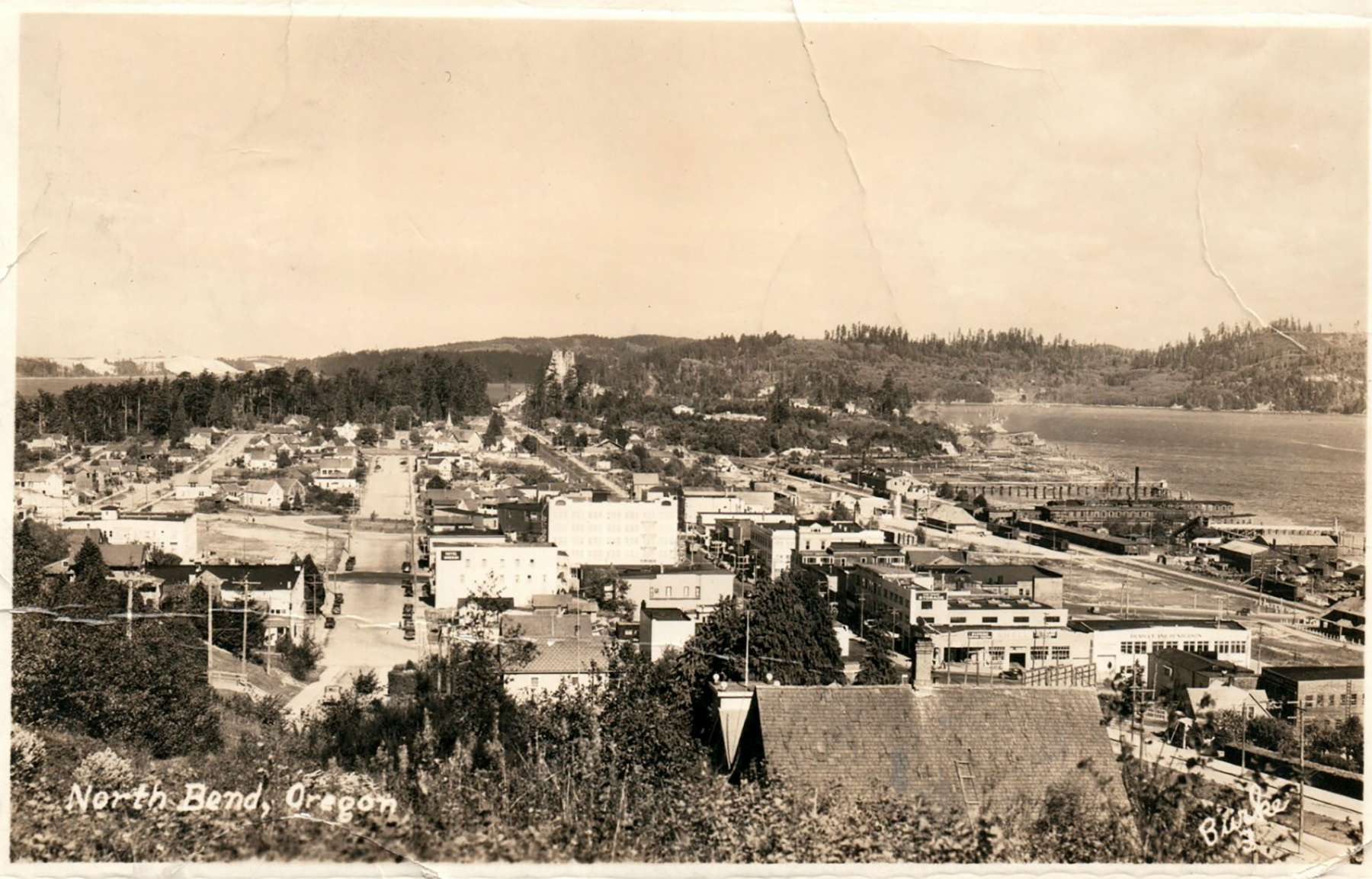
This postcard image shows North Bend as it appeared around the time of the myrtlewood-money printing. The postcard this image came from was postmarked 1938. (Image: Postcard)It wasn’t an original one, or even an uncommon one. As the banking crisis deepened in the early 1930s, lots of local governments around the country had been forced to pay their employees with scrip or IOUs, and they’d been fairly creative with how they did it. The town of Heppner, in the upcountry Columbia Gorge sheep country, printed scrip on sheepskin. Pismo Beach, down in California, used hand-painted clam shells. Actually, North Bend may have gotten the original idea from the town of Tenino, up in Washington. There, the local bank had collapsed a year and a half earlier, and the local Chamber of Commerce had stepped in with a plan by which account holders would assign 25 percent of their bank balance to the Chamber, receiving in exchange dollar bills made of wood, printed on postcard-sized slabs of fir with the local newspaper press. But what made North Bend special was the material they made their money with. A persistent local story claims the myrtle tree grows only in two places on Earth — “Oregon and the Holy Land” — which is not true. Myrtlewoods do not grow in the Holy Land, or anywhere else except the West Coast; and their range here extends well into Northern California. So it’s a special wood — usually the most expensive domestic hardwood on the shelf at your local Woodcrafter’s store — and in addition to being rare, is uniquely beautiful stuff. The other unusual thing about North Bend’s money is the fact that it’s still legal tender in North Bend to this day (although you’d have to be a fool to use it as such — more on that in a minute). North Bend issued two press runs of $1,000 each, the second one using a different design so that fewer coin blanks would break under the weight of the press. Within a few months after the second run, the bank was out of difficulties and the city was once again able to get its municipal paws on its money. So they put the word out: Time to redeem your myrtlewood coins, everyone!
|
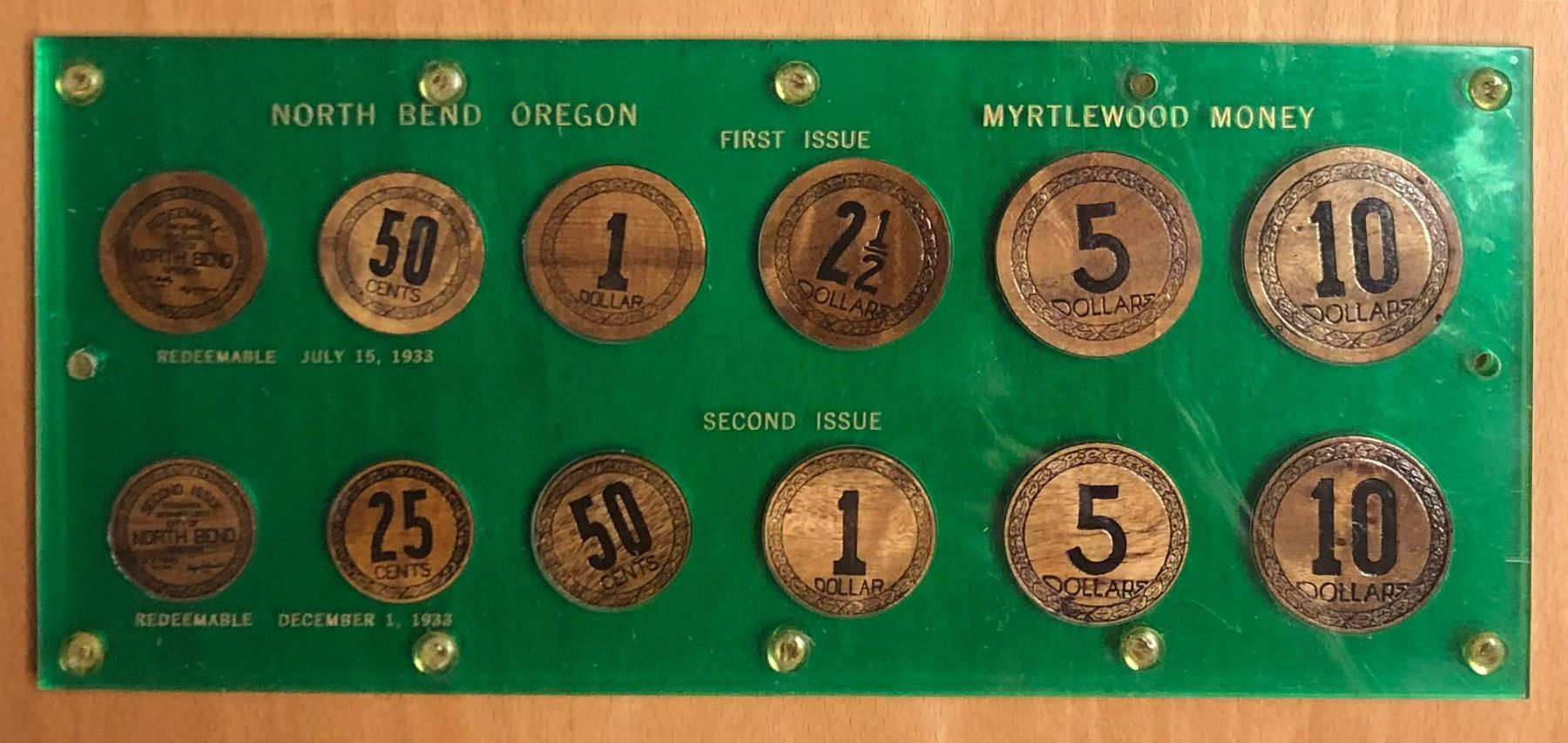
After making several appeals to coin holders to hurry up and bring them in to swap for greenbacks, the city gave up and announced that myrtlewood money would remain legal tender in the City of North Bend forever. Any time someone wanted to come cash one in, the money would be ready. And until a few dozen years ago, this happened from time to time. But the coins have become rare enough to interest collectors, and valuable enough that only a fool would redeem one for face value. Particularly desirable are the $10 coins, which, because they represented a large amount of money in the depths of America’s worst-ever recession, were far more likely to be redeemed for cash in the early 1930s when the city was still destroying redeemed coins. “I would say at a minimum the most common are worth from $20 to $30 on the retail market,” local historian and former coin dealer Dick Wagner told OPB reporter Bryan Vance. “And the more expensive ones get you into the hundreds, and the rarest ones — the $10s — can't be priced because they're so rare that they just don't trade.” As for complete sets of 10 (five from each press run) — fewer than 10 survive. One of them is in the collection at the Chase Manhattan Bank in New York, which acquired it as soon as the second set of coins was minted. One set changed hands for $2,600 in an online auction early 2021; the general consensus is that this was well below what they likely would have sold for at retail. But one thing is for sure: If you bring one of the remaining sets in to City Hall, they’ll at least give you $35.75 for it — face value!
|